Date: 24 Nov 2025
Quantum computing is revolutionizing modern science by enabling phenomena that were once purely theoretical. One of the most striking examples is quantum teleportation, where quantum information is transferred without moving any physical particle. This process relies on entanglement, revealing a deeper structure of nature that classical physics cannot explain. As these capabilities advance, quantum computing is reshaping our understanding of information and the future of scientific discovery.
1. Understanding Quantum Teleportation
Quantum teleportation is the process of transferring the quantum state of a particle, such as a photon or an electron, from one place to another without physically moving the particle itself. Instead of transporting matter, what actually gets transferred is the particle’s quantum information (like its spin or polarization). This transfer becomes possible through a uniquely quantum phenomenon known as entanglement.
In classical communication, information is transmitted using electrical or radio signals that physically travel from one point to another. Quantum teleportation works very differently. Here, the exact state of a particle is “recreated” at a distant location using entanglement and a small amount of classical communication.
It may sound like the information is jumping instantly from one place to another, but quantum teleportation does not break any physical laws. The original particle doesn’t disappear or move; instead, its state is destroyed at the sender’s side and reconstructed at the receiver’s side. This ensures that no information travels faster than light and that the process remains consistent with the rules of quantum mechanics.
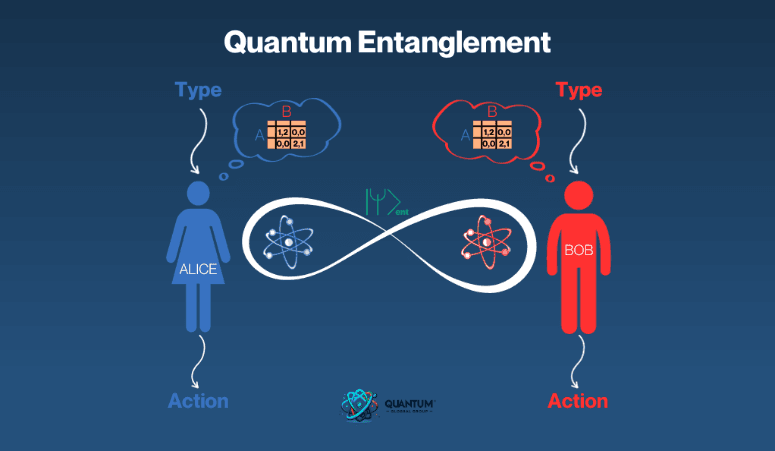
1.1 Quantum Entanglement
Entanglement is a phenomenon where two or more particles become correlated in such a way that the state of one particle cannot be described independently of the state of the others, regardless of the distance between them. When two particles are entangled, any change to the state of one particle instantaneously affects the state of the other, even if they are light-years apart.
2. Quantum Teleportation Protocol
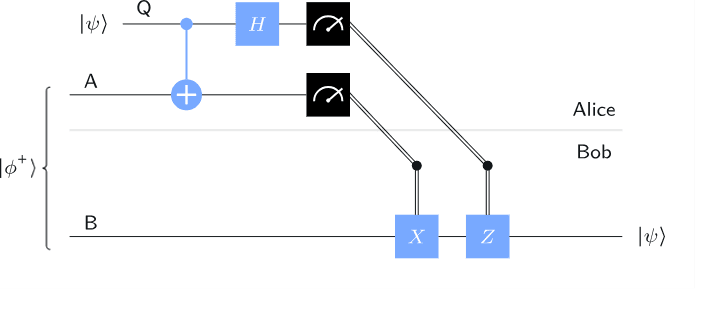
Following steps are involving for the quantum teleportation protocol:
1. Entanglement Preparation: Alice (Qubit A) and Bob (Qubit B) initially share an entangled pair of State ∣ϕ⁺⟩, typically referred to as a Bell state. One state remains with Alice (State A), while the other travels to Bob (State B). Alice then comes in contact with a third qubit Q, which is considered to be unknown to both Alice and Bob.
2. Classical Communication: Alice performs a quantum measurement on her Qubit Q and Qubit A, obtaining two classical bits of information as a result. She then sends these classical bits to Bob through classical communication.
3. Local Quantum Operation: Based on the information received from Alice, Bob applies a specific quantum operation (X and Z gate) to his particle (Particle B).
4. Teleportation: As a result of the measurement and quantum operation, the state of Qubit B is now an identical copy of the initial state of Qubit Q (the particle Alice wanted to teleport).
It is crucial to note that the actual quantum state of Qubit Q is destroyed during the measurement process. The information about its state is teleported to Qubit B without any physical matter transfer.
3. Application
Quantum teleportation has several potential applications across various fields, primarily stemming from its ability to transfer quantum information instantaneously between distant particles. Some of the possible applications of quantum teleportation include:
- Quantum Communication: Quantum teleportation can be utilized to establish secure quantum communication channels. By teleporting the state of a quantum bit (qubit) from one location to another, it enables quantum key distribution, ensuring secure communication that is resistant to eavesdropping.
- Quantum Cryptography: Quantum teleportation can play a vital role in developing quantum cryptographic protocols, making data transmission secure through quantum key distribution.
- Quantum Computing: In quantum computing, teleportation is an essential tool for performing quantum gates between remote qubits. It helps overcome the limitation of short-range interactions between qubits in quantum processors.
- Quantum Error Correction: Quantum teleportation has potential applications in quantum error correction, where it could be used to transfer quantum information between different parts of a quantum system, aiding in fault-tolerant quantum computing.
- Quantum Image and Data Transfer: Quantum teleportation may find applications in quantum image and data transfer, where quantum states representing images or information can be transmitted across distant locations securely and efficiently.
- Quantum Simulation: Quantum teleportation could aid in transferring quantum states between different quantum simulators, enhancing the complexity and capabilities of quantum simulations.