Date:10 Nov 2025
Quantum computing is transforming the way how we think about solving complex problems from cryptography to chemistry to optimization. While most discussions focus on gate model quantum computers such as IBM Q or Google Sycamore, there is another equally fascinating approach making waves in the quantum world: Quantum Annealing.
What is Quantum Annealing?
Quantum annealing is a special type of quantum computing designed to solve optimization problems the kind of problems where you need to find the “best” solution among many possible ones.
Instead of using logic gates and quantum circuits like the IBM Q systems, quantum annealing works by find the minimum energy state of a system, which corresponds to the optimal solution of a problem. This is similar to how, in nature, physical systems tend to settle into the lowest possible energy configuration.
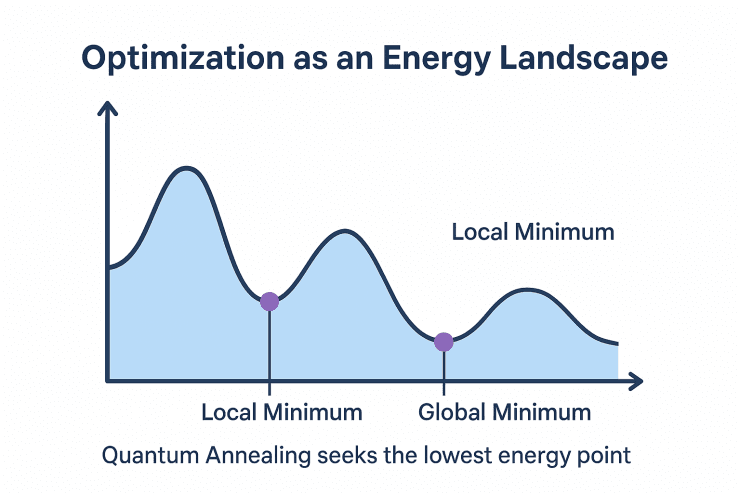
Think of it as trying to find the deepest valley in a mountainous landscape the point where the energy is at its minimum. That valley represents the optimal solution.
How It Works
In quantum annealers, each possible state of the system corresponds to an energy level, these states are simulated in a short time by taking advantage of the superposition and entanglement properties of qubits and the lowest energy result is obtained. The lowest energy state gives the optimal solution or the most likely solution.
For example, consider the Travelling Salesman Problem (TSP), where a salesman visit 50 different cities and return to the starting point starting point with a minimum distance. Mathematically, this problem has 50 factorial possible routes. The goal is to find the route with the shortest distance and least energy situation in other words global minimum.
Quantum annealing relies on an important concept from physics called the Hamiltonian, which represents the total energy of a system. The goal is to gradually evolve the system so that it naturally “falls” into its lowest-energy state.
There are the following working steps given below:
- All states start in a superposition (a mixture of 0 and 1).
- The system’s energy landscape is slowly changed by adjusting the Hamiltonian.
- The qubits interact with one another, shifting and settling toward a configuration that minimizes total energy.
- The final configuration of qubits corresponds to the optimal solution to the problem.
This process is called annealing, inspired by the metallurgical process where materials are slowly cooled to remove defects and achieve stability.
Why Quantum Annealing Matters
Quantum annealing beautifully combines quantum physics with optimization mathematics, offering a powerful new way to solve problems that traditional computers struggle with. Even though it’s still developing, this technology is already making an impact in real-world industries from smart logistics and financial modeling to drug discovery and materials science.
What makes quantum annealing exciting is its ability to handle complex optimization problems far more efficiently than classical methods. These kinds of problems are everywhere in healthcare, finance, and any field that depends on analyzing huge amounts of data to make smarter decisions. Quantum annealing is expected to reach commercial maturity sooner than other quantum technologies, making it a practical bridge between today’s computing and the quantum future.
As data continues to grow in volume and complexity, quantum annealing provides a way to keep up. It is designed to find the best possible solutions from countless possibilities helping accelerate innovation across science, mathematics, and engineering.
While it may not be as versatile as fully programmable quantum computers, quantum annealing shines in the near term. It is naturally more resilient to noise and already available through a few commercial vendors. Meanwhile, universal quantum computers are still in their early research stages meaning quantum annealing is leading the way in showing what quantum computing can really do today.
The Role of Quantum Tunneling
One of the key advantages of quantum annealing is quantum tunneling a phenomenon where qubits can “tunnel” through energy barriers instead of having to climb over them.
In classical computing, optimization algorithms can get stuck in local minima small valleys that are not the lowest possible point. Quantum tunneling allows the system to escape these traps and explore deeper, more optimal valleys (global minima).
In simple words, quantum tunneling lets the system “jump through walls” instead of slowly climbing over them leading to faster and potentially more accurate results.
Real-World Applications
Quantum annealing is especially powerful for problems involving many possible combinations or configurations, such as:
- Route and traffic optimization
- Portfolio management
- Scheduling and logistics
- Molecular and materials modeling
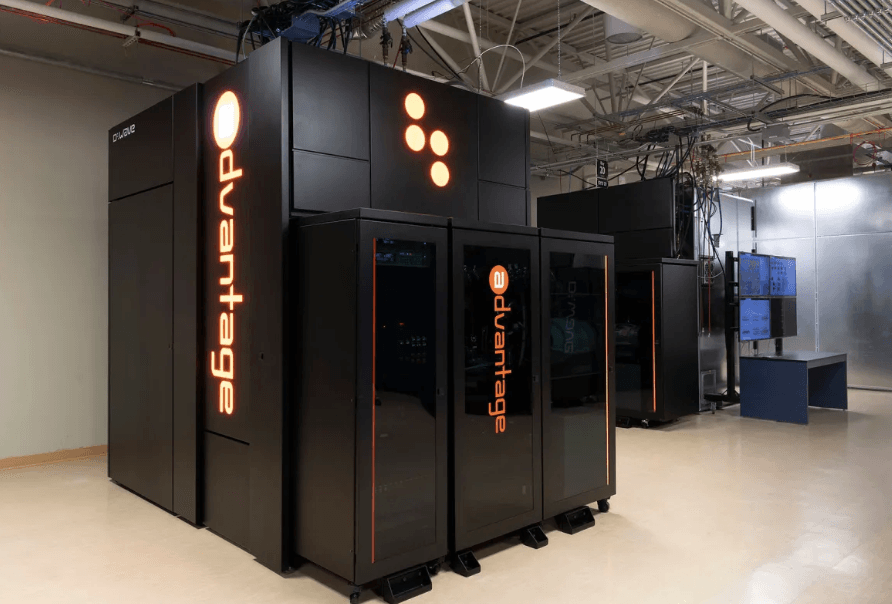
A well-known example is Volkswagen’s project in Lisbon, which used a D-Wave quantum annealer to optimize city traffic in real time.