Date:18 Dec 2025
Quantum Communications Lab is introducing a series of blogs based on curated excerpts from a Book titled, Quantum Communications. The book is part of the Signals and Communication Technology series and was published by Springer in 2015 by the Author: Gianfranco Cariolaro.
We are starting with a timeline outlining the essential discoveries that underpin the development of quantum mechanics.
The timeline is as follows:
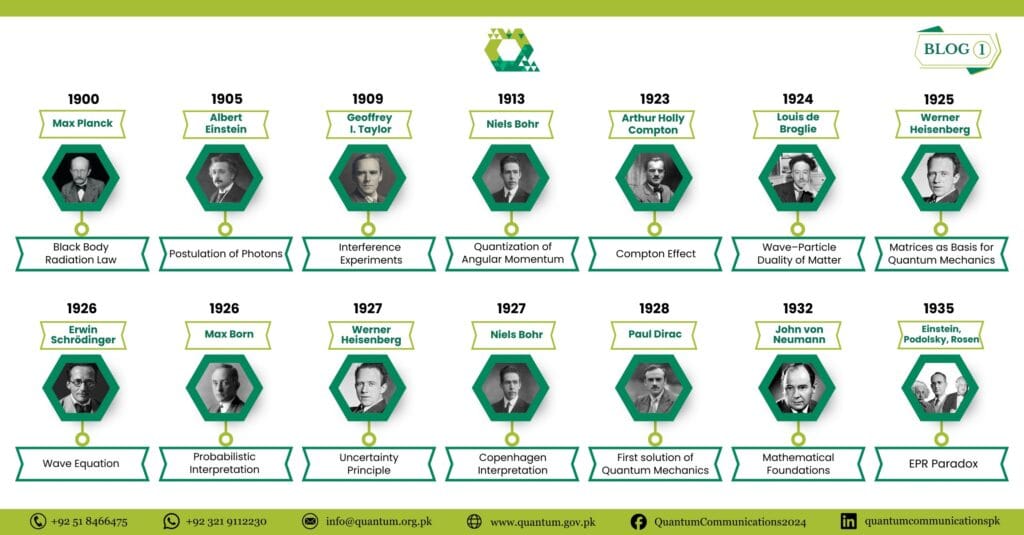
| Year | Scientist(s) | Discovery | Significance |
|---|---|---|---|
| 1900 | Max Planck | Black Body Radiation Law | Proposed that energy is emitted in discrete packets called quanta (E=hν), resolving the “ultraviolet catastrophe.” |
| 1905 | Albert Einstein | Postulation of Photons | Used quanta (later called photons) to successfully explain the photoelectric effect, confirming the particle nature of light. |
| 1909 | Geoffrey Ingram Taylor | Interference experiments | Demonstrated light interference even at very low intensities, hinting at the complex nature of light. |
| 1913 | Niels Bohr | Quantization of Angular Momentum | Hypothesized that electrons transition between discrete states to explain the regular emission spectrum of the hydrogen atom. |
| 1923 | Arthur Holly Compton | Compton effect | Further demonstrated the particle-like nature of light when scattering from electrons. |
| 1924 | Louis de Broglie | Wave–Particle Duality of Matter | Extended duality to include particles with mass (like electrons), suggesting they can also behave as waves (λ=h/mv). |
| 1925 | Werner Heisenberg | Matrices as basis for Quantum Mechanics | Developed the matrix formulation, one of the first complete mathematical frameworks for Quantum Mechanics. |
| 1926 | Erwin Schrödinger | Wave Equation | Developed the fundamental wave equation (Hψ=Eψ) to explain atomic behavior, marking a move toward the Maturity phase. |
| 1926 | Max Born | Probabilistic Interpretation | Stated that the square of the wavefunction gives the probability density of finding a particle. |
| 1927 | Werner Heisenberg | Uncertainty Principle | Asserted that it’s impossible to know two conjugate properties (like position and momentum) simultaneously with arbitrary precision (ΔxΔp≥4πh). |
| 1927 | Niels Bohr | Copenhagen Interpretation | The dominant interpretation of Quantum Mechanic’s probabilistic and complementary nature. |
| 1928 | Paul Dirac | First solution of QM explaining spin | Developed the relativistic equation for the electron, naturally incorporating the concept of electron spin. |
| 1932 | John von Neumann | Mathematical Foundations | Provided the rigorous mathematical structure for Quantum Mechanics using Hilbert spaces. |
| 1935 | Einstein, Podolsky, and Rosen | EPR Paradox | Presented a thought experiment questioning the completeness of Quantum Mechanics, leading to later discoveries on entanglement. |