Date: 03 March 2026
Quantum Mechanics is built on a precise mathematical framework that allows us to describe physical reality at its most fundamental level. At the heart of this framework lie vector spaces and, more specifically, Hilbert spaces. These abstract structures provide the environment in which quantum states, measurements, and physical predictions are defined.
A vector space is a set of objects, called vectors, that can be combined by adding them together or scaling them using numbers.
In Quantum Mechanics, these scalars are complex numbers. What makes a vector space special is that it follows a consistent set of rules: vectors can be combined, scaled, and reversed, while always remaining within the same space. These simple rules ensure mathematical consistency and allow complex systems to be described in a unified way.
Common examples of vector spaces include familiar finite collections, such as ordered lists of numbers, as well as infinite collections, such as sequences or signals that evolve over time. In fact, many signals used in engineering and communications naturally form vector spaces, highlighting the practical relevance of these ideas beyond physics.
Within a vector space, smaller structures called subspaces can exist. These are subsets that still behave like full vector spaces. Using combinations of vectors, we can generate entire spaces from smaller sets, and concepts like linear independence help determine whether vectors contribute genuinely new information or simply repeat what is already known.
To move closer to physical applications, vector spaces are enriched with an inner product. This mathematical operation allows us to define intuitive concepts such as the length of a vector (called its norm), the distance between two vectors, and the idea of angle or similarity. These ideas are crucial in Quantum Mechanics, where the inner product determines probabilities and measurement outcomes.
A particularly important property is completeness. In a complete space, every sequence that should converge actually does converge within the space. When a vector space has an inner product and is complete, it is called a Hilbert space.
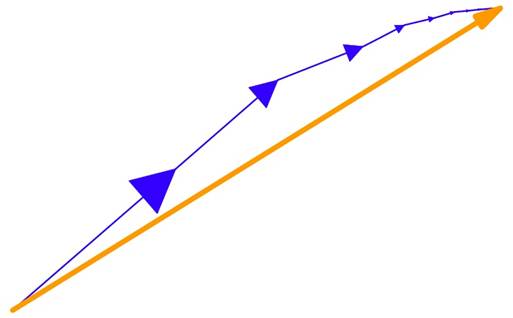
A Complete space makes it possible to take the limit of approximations and define a solution. For example, in a Hilbert space completeness means that a series of vectors (in blue) results in a well-defined net displacement vector (in orange).
Hilbert spaces are the natural setting of Quantum Mechanics, ensuring that quantum states evolve predictably and that physical calculations remain well-defined.
In essence, Hilbert spaces provide the mathematical backbone of Quantum Mechanics. From simple vector addition to the sophisticated description of quantum states, they form the bridge between abstract mathematics and the physical laws governing the quantum world. In the next blog, we will explore Hilbert spaces in more detail and explain why they are fundamental to modern quantum theory.