Date:10 Nov 2025
Quantum Communication represents a revolutionary leap in how information is transmitted securely across the world. Unlike traditional data transfer methods that rely on classical bits, quantum communication harnesses the power of qubits quantum particles capable of existing in multiple states simultaneously. This enables the creation of Quantum Key Distribution (QKD) systems, which allow two parties to share encryption keys with absolute security guaranteed by the laws of quantum mechanics. Any attempt to intercept the transmission alters the quantum state itself, immediately revealing the presence of an intruder. Leading nations and tech giants are already testing quantum networks that promise to redefine cybersecurity, especially for defence, finance, and cloud systems.
The latest advancements in satellite-based QKD, photonic chip integration, and quantum repeaters are driving the world closer to a global quantum internet. Research collaborations in Europe, China, and the U.S. have demonstrated long-distance entanglement distribution laying the foundation for intercontinental quantum links. With the rise of post-quantum cryptography and quantum-secure networks, organizations are racing to adapt to this technological shift. Quantum communication isn’t just the next step in data security it’s the beginning of a new era where privacy, speed, and trust will coexist through the principles of physics, not just algorithms.
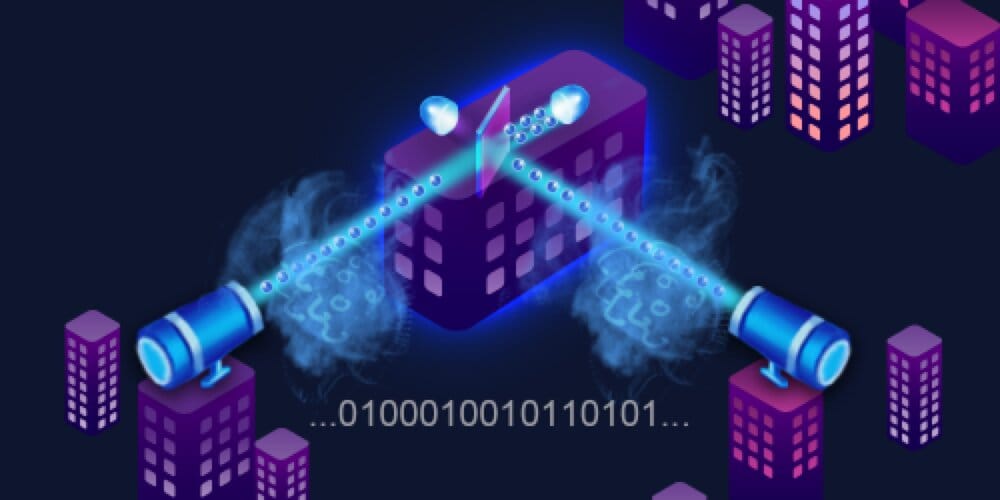
Quantum Communication and Cybersecurity: The Post-Quantum Shift
As the world stands on the brink of a technological revolution, quantum communication is redefining the future of cybersecurity. Traditional encryption methods once considered unbreakable are now vulnerable to the immense computational power of quantum computers. This transformation is driving a rapid global shift toward quantum-safe networks built on Quantum Key Distribution (QKD) and entanglement-based encryption. Quantum communication relies on the unique properties of photons the fundamental particles of light to generate encryption keys that cannot be intercepted, copied, or altered. Unlike classical encryption, where keys can be mathematically predicted, QKD leverages the laws of quantum mechanics to detect any attempt at eavesdropping in real time. This makes it virtually impossible for hackers or state-level adversaries to breach the communication channel without detection.
In 2025, the industry has seen remarkable breakthroughs in continuous-variable QKD (CV-QKD) and integrated photonic systems. These innovations have demonstrated that quantum communication can seamlessly merge with existing fiber-optic networks, offering real-time protection for financial transactions, healthcare data, defense communication, and telecommunication systems. This integration marks a major milestone toward scalable and cost-effective quantum-secure infrastructure. Enterprises across sectors finance, defense, healthcare, and telecom are now developing quantum-ready cybersecurity frameworks. These systems combine quantum-resistant algorithms, classical encryption, and quantum communication channels to create multi-layered protection against evolving threats. The hybrid model ensures resilience even during the gradual transition from classical to quantum networks. Moreover, governments and research institutions worldwide are investing heavily in quantum internet prototypes, linking quantum computers, sensors, and communication nodes across secure quantum channels. This will redefine how cloud computing, data centers, and telecommunication providers handle sensitive information in the near future. Experts predict that within the next decade, quantum-secure communication will become the global cybersecurity standard. As quantum computing advances, the importance of adopting quantum encryption technologies will only intensify. From banking systems to national defense grids, the fusion of quantum communication and cybersecurity promises a new era of privacy, reliability, and data integrity. The post-quantum shift isn’t just an evolution it’s a revolution. Quantum communication is not the future of cybersecurity; it is the foundation of tomorrow’s digital world, reshaping how we protect, connect, and communicate in the quantum age.